
INDUSTRIAL
TECHNOLOGIES
Our technology scope covers the entire bulk material handling process: raw material reception, silo unloading, conveying, separation, dosing and flow control, through to the final delivery of end products in small bags, big bags or by bulk loading into trucks.
See all Industrial Technologies

 Magnetic Separation Equipment

 Slide gates

 Rotary Valves

 Vibrating Equipment

 Weighing & Feeding Systems
 Mechanical & Pneumatic Conveying

 Vacuum Cleaners & Dust Filters

 Filling & Emptying Systems

 Loading Chutes

 Packaging, Palletizing, Wrapping Systems
Mechanical & Pneumatic Conveying
Pneumatic and mechanical systems that transport bulk solids efficiently — from dilute-phase and vacuum conveying to tubular chain conveyors
We supply and integrate mechanical and pneumatic conveying systems engineered to transport bulk solids efficiently across distinct processing configurations.
How to Select a Conveying System
By analyzing material characteristics and behaviour such as particle size distribution, bulk density, abrasiveness and moisture content, we implement the optimal transport methodology to achieve the desired capacity and conveying distance & cinfiguration desired, minimize material degradation and maintain product containment, where case.
Types of Conveying Systems
Types of conveying systems include Dilute Phase Conveying, which transports bulk solids through pipelines using high-velocity air; Vacuum Conveying, which moves material under negative pressure for contained transfer; and Tubular Chain Conveyors (Mechanical), which gently transport bulk materials through enclosed tubes using a chain-and-disc system.
Pneumatic vs Mechanical Conveying
Mechanical conveying utilizes direct physical force via rigid or flexible internal components to transport materials along a fixed path. These systems are energy-efficient and ideal for shorter to medium distance routing, with limited changes in direction.
Pneumatic conveying utilizes differential air pressure to suspend and propel bulk materials through a sealed network of pipelines. This method offers total routing flexibility and absolute dust-tight containment over long horizontal and vertical distances.
How Pneumatic Conveying Works — Pressure vs Vacuum
In pressure conveying, compressed air pushes bulk material through the pipeline from the feeding point to one or more destinations. In vacuum conveying, negative pressure pulls material toward a receiving unit. Pressure systems suit longer distances and higher capacities, while vacuum systems support contained, dust-controlled transfer.
Applications
Silo & Hopper Discharge, Bag and Big-Bag Unloading, Process Equipment Feeding, Mixer and Reactor Charging, Material Transfer Between Production Stages, Storage Silo Filling, Packaging Line Feeding, Multiple-Destination Distribution.
Dilute phase conveying is a pneumatic transport method used to move bulk materials through pipelines using a high-velocity airflow. The material is conveyed in suspension, meaning particles are carried along within the air stream rather than moving in a dense layer along the pipe.
This type of system is typically applied for fine powders and light granular products that can be conveyed without degradation. Due to the higher air velocities involved, the material remains continuously dispersed, allowing for flexible routing over longer distances and through complex layouts.
The installation usually includes a blower or compressor, a feeding device (such as a rotary valve), conveying pipelines, and a separation unit like a cyclone or filter at the receiving end. Control of air velocity and pressure is essential to ensure reliable transport while avoiding excessive wear or product damage.
Dilute phase conveying systems represent a flexible solution for transferring materials between process stages, especially when we speak about long distances, elevation, direction changes and higher capacities.
Industries we serve
Tubular chain conveyors are used for the enclosed transport of bulk materials along fixed routes, particularly where dust containment, product integrity and flexible layout are required. The system moves material inside a pipe, making it suitable for applications where spillage or contamination must be minimized or avoided.
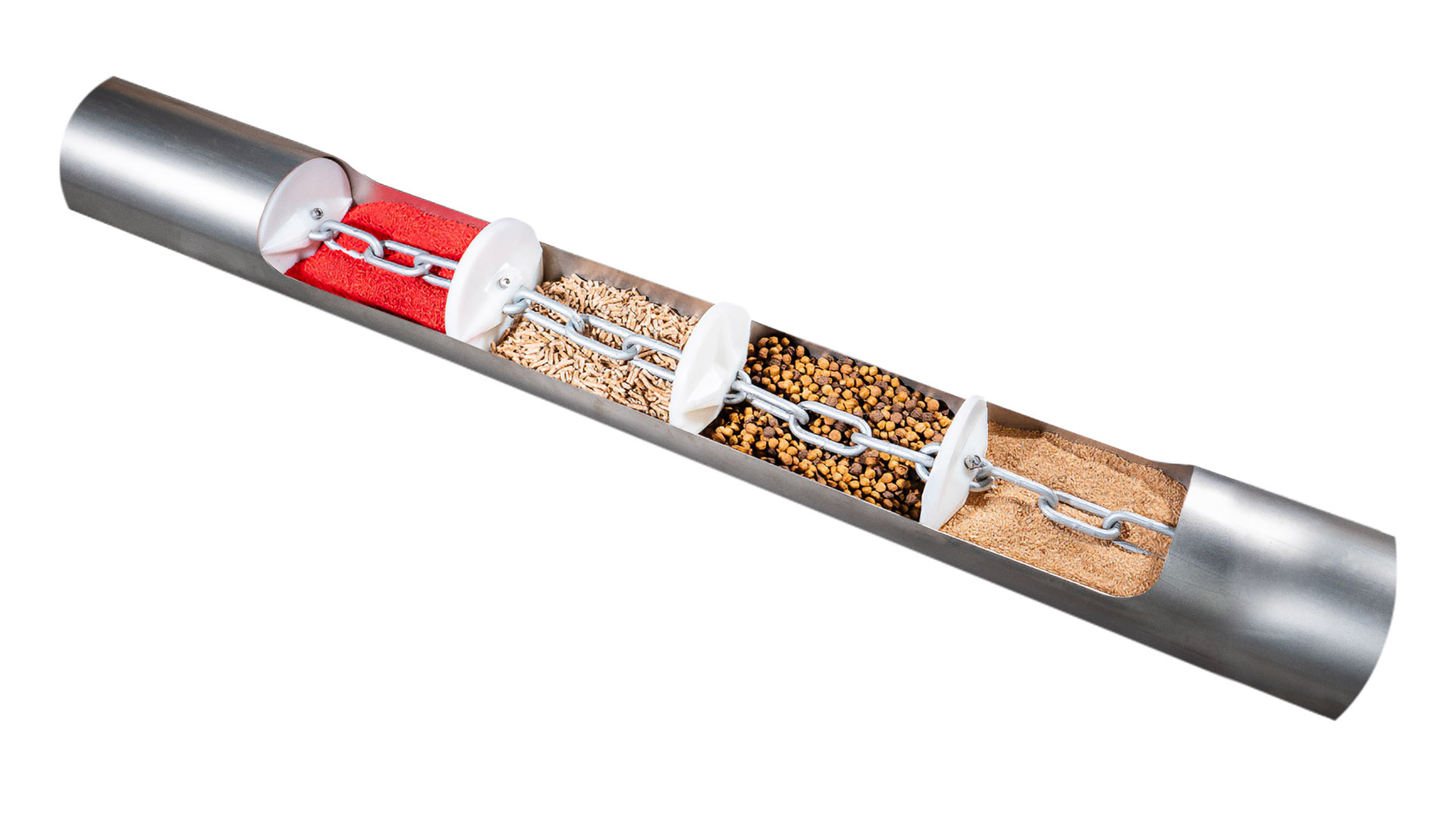
Material is conveyed by a chain fitted with discs, which travel through the tubular casing and gently drag the product from the inlet to the outlet. This low-speed conveying principle reduces material degradation and limits the generation of dust, making it appropriate for fragile, mixed or abrasive materials.
One of the main advantages of this type of conveyor is its ability to follow complex paths, including horizontal, vertical and inclined sections, with multiple inlets and outlets along the route. This allows efficient use of space and easy integration into existing plant layouts.
They can handle a wide spectrum of bulk materials—from fine powders and granules to fragile or more coarse products—while ensuring gentle and contained transport throughout the process.
Industries we serve
Vacuum Conveyors can transport numerous granulated bulk materials, small parts, powders, and pigments under vacuum in a lean and dense phase through hoses and pipes. They are easy to install and quite simple to operate. By using vacuum these systems can keep the production environment clean.
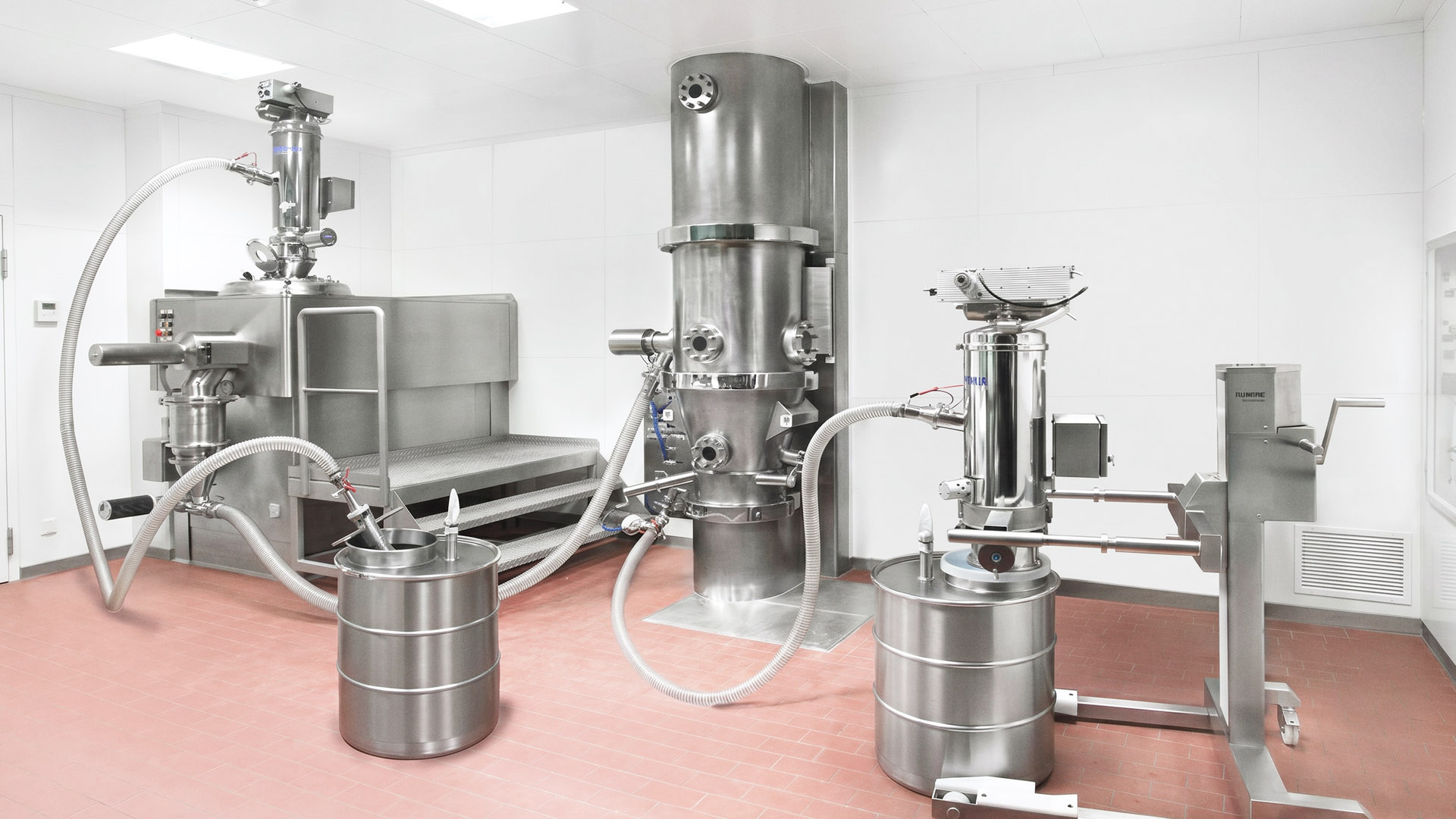
They can transfer nano-sized material and fine dust with particles size from 0,1 µm up to bigger sized tablets, sweets, or bottle caps, for example. They are good for highly abrasive powders, mixtures, light filling materials (such as fumed silica with a bulk density of only 0,05 kg/l), but also work well with metal powders which can have bulk densities of up to 10 kg/l.
The heart of a vacuum conveyor system is the vacuum conveyor. Our modular series are available in different sizes and thus cover a wide performance spectrum. At the same time, requirements such as hygienic design or pressure shock resistance can also be met. ATEX execution is possible.
Industries we serve
Frequently Asked Questions
What is pneumatic conveying?
Pneumatic conveying is the transport of dry bulk solids — powders, granules and pellets — through enclosed pipelines using the flow of air or gas and a pressure difference. It is dust-tight, hygienic and routes flexibly over long distances.
What is the difference between pneumatic and mechanical conveying?
Pneumatic conveying uses air pressure to move material through sealed pipelines, giving total routing flexibility, dust-tight containment and long-distance transport, but uses more energy. Mechanical conveying uses direct physical force through rigid or flexible components — more energy-efficient for shorter to medium distances with limited direction changes. ROCOM selects the method based on the material and plant layout.
What is the difference between dilute phase and dense phase conveying?
Dilute (lean) phase suspends particles in a high-velocity airstream — ideal for light, free-flowing materials over long distances. Dense phase moves material slowly in slugs at low velocity and higher pressure — gentler on fragile or abrasive products, reducing degradation and pipeline wear.
What is vacuum conveying?
Vacuum conveying is pneumatic conveying that uses negative pressure (suction) to pull material through the line. Because any leak draws air inward, it is inherently dust-tight and hygienic — well suited to fine, abrasive or sensitive powders in lean or dense phase, with ATEX executions available.
How do I choose between pneumatic and mechanical conveying?
The choice depends on material characteristics (particle size, bulk density, abrasiveness, moisture, fragility), conveying distance and routing, required capacity, dust/hygiene/ATEX requirements and energy efficiency. ROCOM analyses these factors to implement the optimal transport method for your process.
Our Partners


















Contact Us
We look forward to discussing with you!