
INDUSTRIAL
TECHNOLOGIES
Our technology scope covers the entire bulk material handling process: raw material reception, silo unloading, conveying, separation, dosing and flow control, through to the final delivery of end products in small bags, big bags or by bulk loading into trucks.
See all Industrial Technologies

 Magnetic Separation Equipment

 Slide gates

 Rotary Valves

 Vibrating Equipment
 Weighing & Feeding Systems

 Mechanical & Pneumatic Conveying

 Vacuum Cleaners & Dust Filters

 Filling & Emptying Systems

 Loading Chutes

 Packaging, Palletizing, Wrapping Systems
Weighing & Feeding Systems
Loss-in-weight and gravimetric feeders, weigh feeders and dosing systems for accurate, consistent metering of bulk materials.
Weighing and feeding systems are applied where material dosing must be both accurate and consistent over time. They are typically used in processes where even small deviations in quantity can influence product quality, formulation or downstream performance.
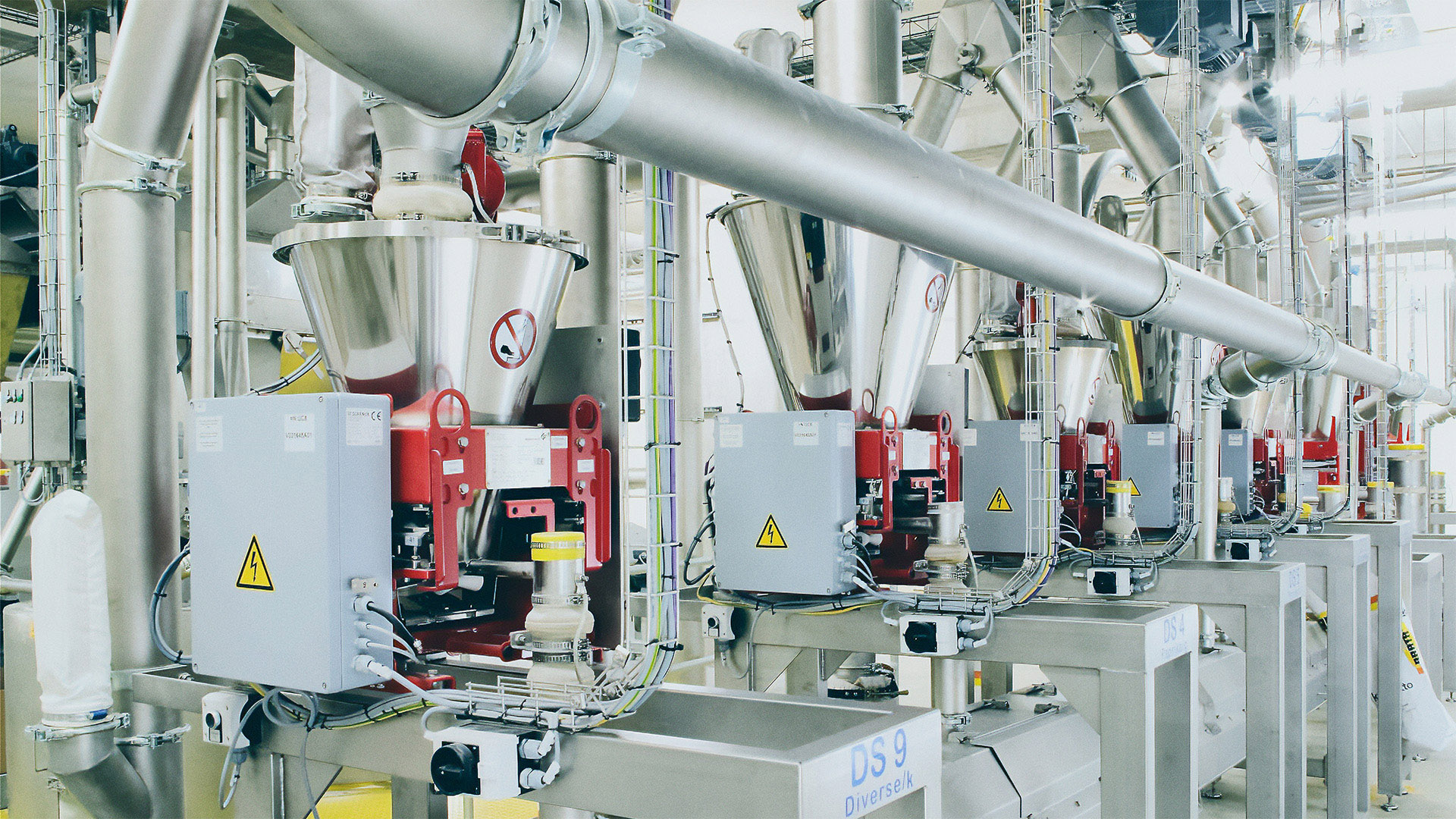
The principle is based on continuous weight measurement combined with controlled material extraction. By monitoring the mass flow in real time, the system can adjust the feed rate to maintain a precise setpoint, independent of variations in bulk density, flow behavior or upstream conditions.
These solutions are particularly suited for handling powders and fine bulk materials, where stable and repeatable dosing is difficult to achieve with volumetric methods alone. Different configurations, such as gravimetric feeders, allow high dosing accuracy even in demanding industrial environments.
In daily operation, precision weighing and dosing ensures reliable process control, reduces material losses and keeps production within defined tolerances without manual or operator intervention.
Gravimetric vs Volumetric Feeding
Volumetric feeders deliver a set material volume based on feeder speed, so changes in bulk density can affect the actual mass flow, while gravimetric feeders continuously measure weight and adjust feeder speed to maintain the target mass flow, making them better suited to applications requiring accurate, consistent dosing.
How a Loss-in-Weight Feeder Work
The key components — Hopper, Dosing Unit, Load Cells, Controller work together as the hopper stores material, the dosing unit discharges it, load cells continuously measure weight loss, while the controller adjusts feed speed to maintain the required mass flow.
How to Select a Feeder
Accuracy, feed rate & continuous vs batch mode determine whether the process requires precise mass control, constant feeding or predefined batch quantities. Material behaviour, hygiene & ATEX guide the feeder design, contact materials, cleaning access and protection measures needed for safe, stable flow and reliable dosing.
Types of Weighing & Feeding Equipment
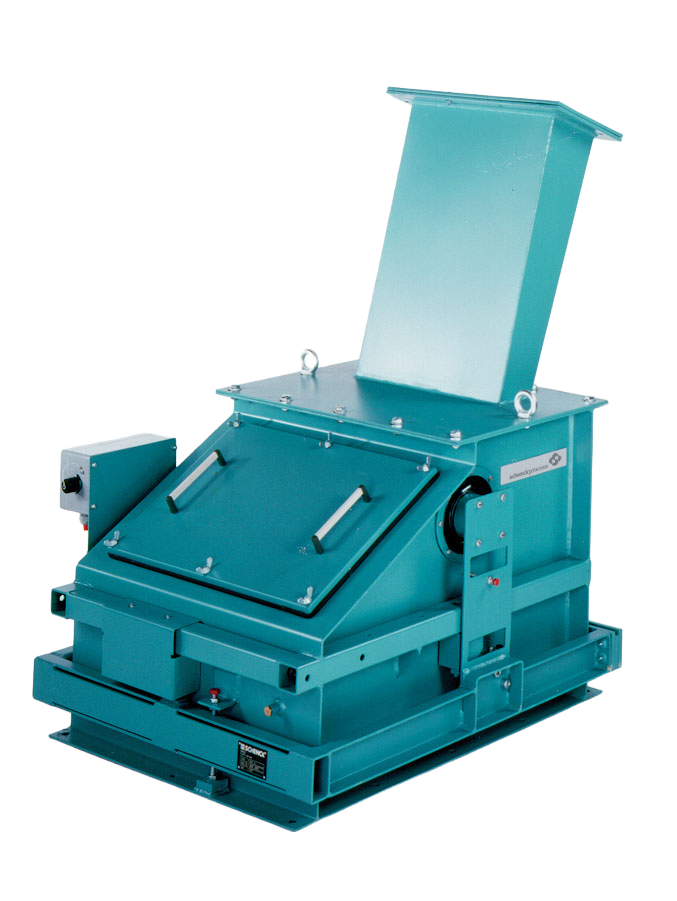
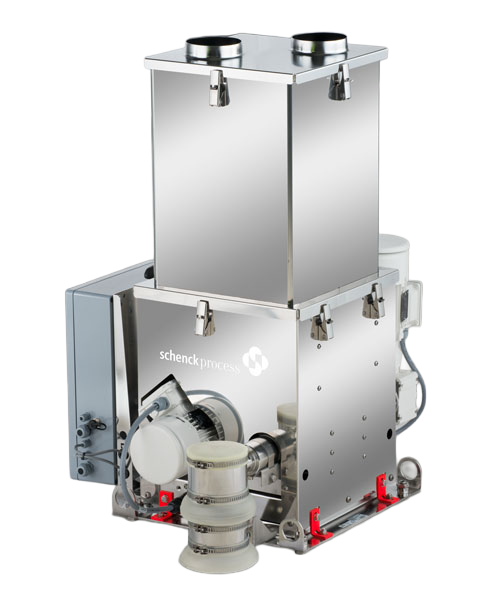
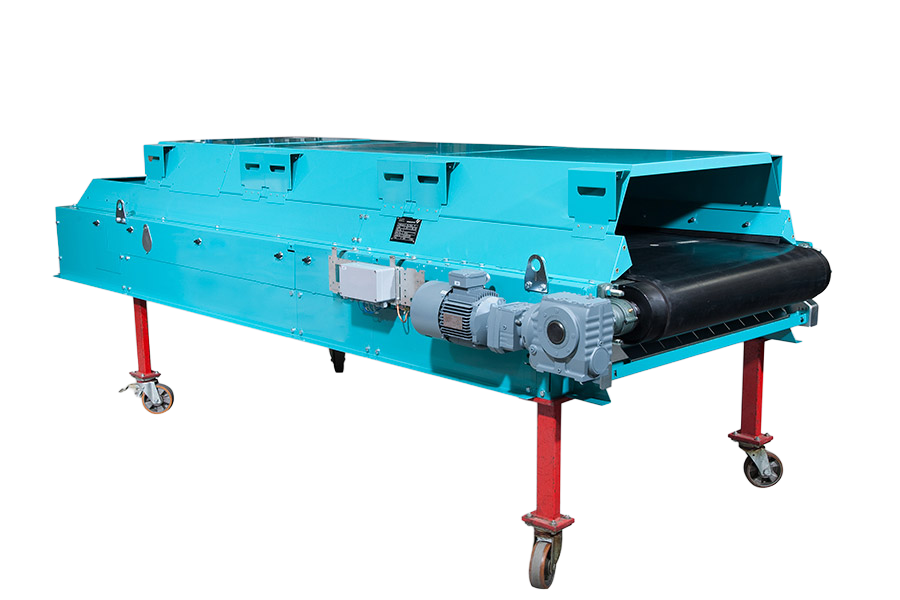
Loss-in-Weight (Gravimetric) Feeders continuously measure weight loss to maintain accurate mass flow. Volumetric Feeders dose a fixed material volume based on feeder speed. Weigh Belt Feeders weigh and regulate bulk solids on a moving belt, while Batch Weighing & Dosing Systems deliver predefined quantities for consistent, repeatable production batches.
Applications
Silo & Hopper Discharge, Continuous Process Feeding, Batch Dosing & Recipe Preparation, Mixer, Extruder & Reactor Feeding, Conveyor Loading, Packaging & Filling Lines, Pneumatic Conveying Feed Points.
Weighing & Feeding Systems products
Industries we serve
- Food & Dairy
- Grains, Feed & Petfood
- Plastic & Rubber
- Chemicals & Fertilizers
- Recycling
- Building Materials
Frequently Asked Questions
What is a loss-in-weight feeder?
A loss-in-weight feeder is a gravimetric feeder that meters bulk materials by continuously weighing the feeder, hopper and material on load cells and measuring how fast the weight drops, then adjusting the dosing screw or vibratory tray to hold an exact target feed rate.
What is the difference between gravimetric and volumetric feeding?
A volumetric feeder delivers a set volume of material per unit time with no weight feedback — simple and lower-cost, but accuracy depends on consistent bulk density. A gravimetric (loss-in-weight) feeder measures the actual mass being discharged and adjusts speed to hold the rate, compensating for density and moisture changes for much higher accuracy.
How does a loss-in-weight feeder maintain accuracy?
Load cells continuously weigh the system; the controller compares the real weight-loss rate to the setpoint and adjusts the screw or vibratory speed in a closed loop. During hopper refill it briefly runs in volumetric mode, and flow aids prevent bridging — delivering typical continuous accuracy of about ±0.25–1%.
What is a weigh feeder?
A weigh feeder combines material transport — for example a belt or screw — with integrated weighing (load cells plus a speed sensor) to measure and control the mass flow rate continuously. It is used for high-capacity continuous dosing where a steady, verified feed rate is required.
Which industries use weighing and feeding systems?
They are used across food & dairy, plastics & rubber, chemicals & fertilizers, grains/feed/pet food and pharmaceuticals — anywhere recipe accuracy, consistent dosing and batch tracking are critical to product quality and compliance.
Our Partners


















Contact Us
We look forward to discussing with you!